Constantin Nitsche
For Constantin Nitsche, painting begins with an impossible gesture: trying to hold on to something that continually escapes. ‘Sometimes I come very close, and that’s where the satisfaction lies. You’re this close, and then it’s like sand in your hand – you try to hold onto it, but it slips away,’ he says. His second exhibition at the gallery, Les mains, takes its title from one of Franz Kafka’s letters to Milena Jesenská, in which he writes, ‘I can’t hold enough of you in my hands’ [Ich kann doch nicht genug von Dir in Händen halten]. For Nitsche, the sentence echoes the experience of painting: every image approaches something it can never fully possess.
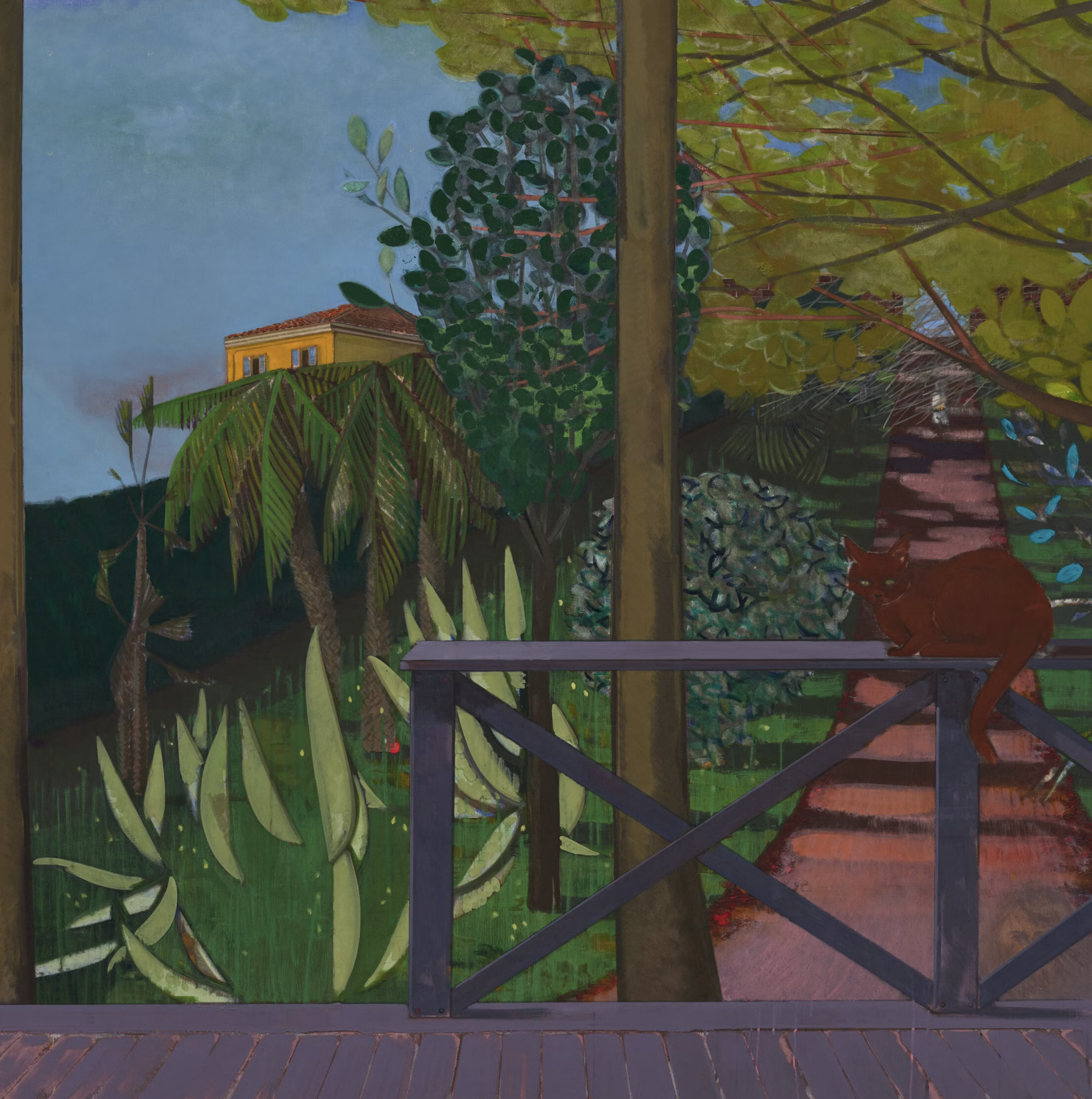
Developed in his studio in Marseille, the works are created through a process of layering, revision and subtraction. Earlier states of the paintings are not always entirely erased, often surviving as ghostly traces beneath the surfaces. An initial idea gradually gives way to something less predictable, as the work begins to determine its own course. The artist follows as much as he directs. A painting reaches its final form through restraint: the moment at which another gesture would diminish rather than deepen what already exists on the canvas. This is evident in Nature morte au melon, where foreground, background and the printed tablecloth seem indivisible.
Kafka has accompanied Nitsche since adolescence. What continues to resonate is the instability of his writing, where certainty is constantly unsettled and meaning shifts from one sentence to the next. This openness runs through the paintings. The images appear to be suspended, resisting fixed identities or stable narratives. Les mains moves between self-portraiture, still life and fragments of everyday life. Observation and invention are never fully separated. The paintings remain rooted in reality while gently loosening its logic.
This atmosphere owes as much to childhood as it does to literature. The German fairy tales that Nitsche grew up with — in which beauty and violence exist side by side and wonder is rarely free from unease — are another reference point. Beneath the calm surfaces of the works lies an awareness that even the most mundane things can be surprisingly charged, unknowable even. Melancholy, humour and tenderness coexist, while meaning accumulates through sustained looking.
Followers of Nitsche’s work will recognise motifs that return not only in Les mains but across his wider oeuvre. Plants, interior decor and domestic objects recur altered by repetition, memory and circumstance, each painting approaching familiar subjects from a slightly different direction. In this exhibition, the Ficus plant, seen in earlier works, appears in La Visite VI. A yellow floral screen and a crystal ball link the latter work with La Canicule III. Pink flowers blossom across numerous canvases while the artist’s wife, a constant presence in his work, is the protagonist throughout. The paired paintings Les mains and La main, which speak to the exhibition title, mirror one another. In one, she holds the recognisable pink flower; in the other, a red flower resting on a table reappears in the hand of the artist. Together, they suggest not possession but exchange. Elsewhere, the Mediterranean landscape surrounding Marseille enters the studio. L’horizon (Février) observes the sea at a particular time and from a specific vantage point, while Le Roucas Blanc II begins in observation before becoming, via the act of painting, something new altogether.
Among the works is a self-portrait of the artist as Pinocchio, with a wooden nose and an oversized hat. The figure is at once candid and performative, recognisable yet faintly disguised. Nitsche has long been fascinated by the story of Geppetto and the human puppet. Here, the motif alludes to the paradox of self-portraiture. Although we tend to read such paintings as authentic likenesses, they are also acts of construction. In this work, the artist stands before one of his favourite paintings, James McNeill Whistler’s Nocturne in Black and Gold — The Falling Rocket (c. 1875; Detroit Institute of Arts). The dying fireworks in the latter work subtly reflect the idea of transience and the self-portrait’s own passage through time: the longer it remains in the studio, the less fixed the likeness becomes. Looking turns into searching; certainty gives way to revision. By the time Nitsche finishes the painting, he too has changed. The portrait no longer captures a single moment, but the period that has elapsed between its beginning and its completion.
Les mains unfolds through these subtle shifts, where images are elusive and open to interpretation, like suspended moments without a clear beginning or end. Rather than attempting to possess the world, the paintings remain attentive to what continually slips beyond reach.
Constantin Nitsche (b. 1987, Ludwigshafen, Germany) lives and works in Marseille. He studied painting at the Kunstakademie Düsseldorf. Selected institutional exhibitions include La Valse des fleurs, Collection Lambert, Avignon, France (2025); Oranges et Lavande, Xavier Hufkens, Brussels, Belgium (2023); Blauregen, La Traverse, Marseille, France (2022); VIOLETTE, O-Town House, Los Angeles, CA, USA (2021); Everything is Personal, TRAMPS, New York, NY, USA (2020); Untitled, Parkhaus im Malkastenpark, Düsseldorf, Germany (2019); and Salon des Amateurs, TRAMPS, London, UK (2018).
Tatiana Trouvé
Xavier Hufkens is pleased to present a major exhibition of new work by Tatiana Trouvé, her first solo exhibition in Brussels. Occupying three levels of the gallery, The Auxiliaries unfolds through an ever-expanding practice encompassing sculpture, drawing, and installation. Trouvé’s works inhabit an intermediate zone where multiple realities coexist, each interlinked within a practice that is both generative and regenerative. ‘All the elements that make up worlds connected to each other through affinities, echoes, reminiscences, and how these liaisons map out a shared wandering, without origin or end, in a completely open ecosystem’, Tatiana Trouvé notes.
The exhibition opens with L’Inventario [The Inventory] (2026), a provisional-looking shelving structure resembling cardboard cast in aluminium. Combining still-life compositions with empty shelves, the installation alludes to the artist’s storage and the studio as a place of transformation, where objects and their relationships exist in a state of perpetual becoming. Rather than suggesting accumulation, the work evokes absence and depletion. As Trouvé observes: ‘The idea is to get into a space where a few elements still survive, but where the essentials are already gone.’
Les Colliers des villes [City Necklaces] are composed of objects collected by the artist during her travels. Cast in bronze, brass, steel or aluminium before being painted, these fragments become condensed itineraries carrying traces of encounters and lived experience, recalling the interconnected journeys of Italo Calvino’s Invisible Cities (1972). Travel and temporality likewise shape the latest iteration of I cento titoli [A Hundred Titles], a work whose title changes every year over one hundred years (1968—2068). Cast in bronze, the ‘dis-adjusted’ suitcase floats between a temporal and a conceptual journey.
Travelling, movement, mapping and circularity also underpin On the Eve of Never Leaving (2026), a work based on sound pollution measurements taken around the Boulevard Périphérique that encircles Paris. Here, sounds become lines, movements become structures, and an invisible phenomenon acquires material presence. Composed of truncated loops and segments, the sculpture echoes the continuous circuit of the ring road, while the adjoining plaster panel, a fragment of Trouvé studio’s wall, recalls the acoustic barriers lining the motorway, linking the artist’s studio life to the murmuring of the world.
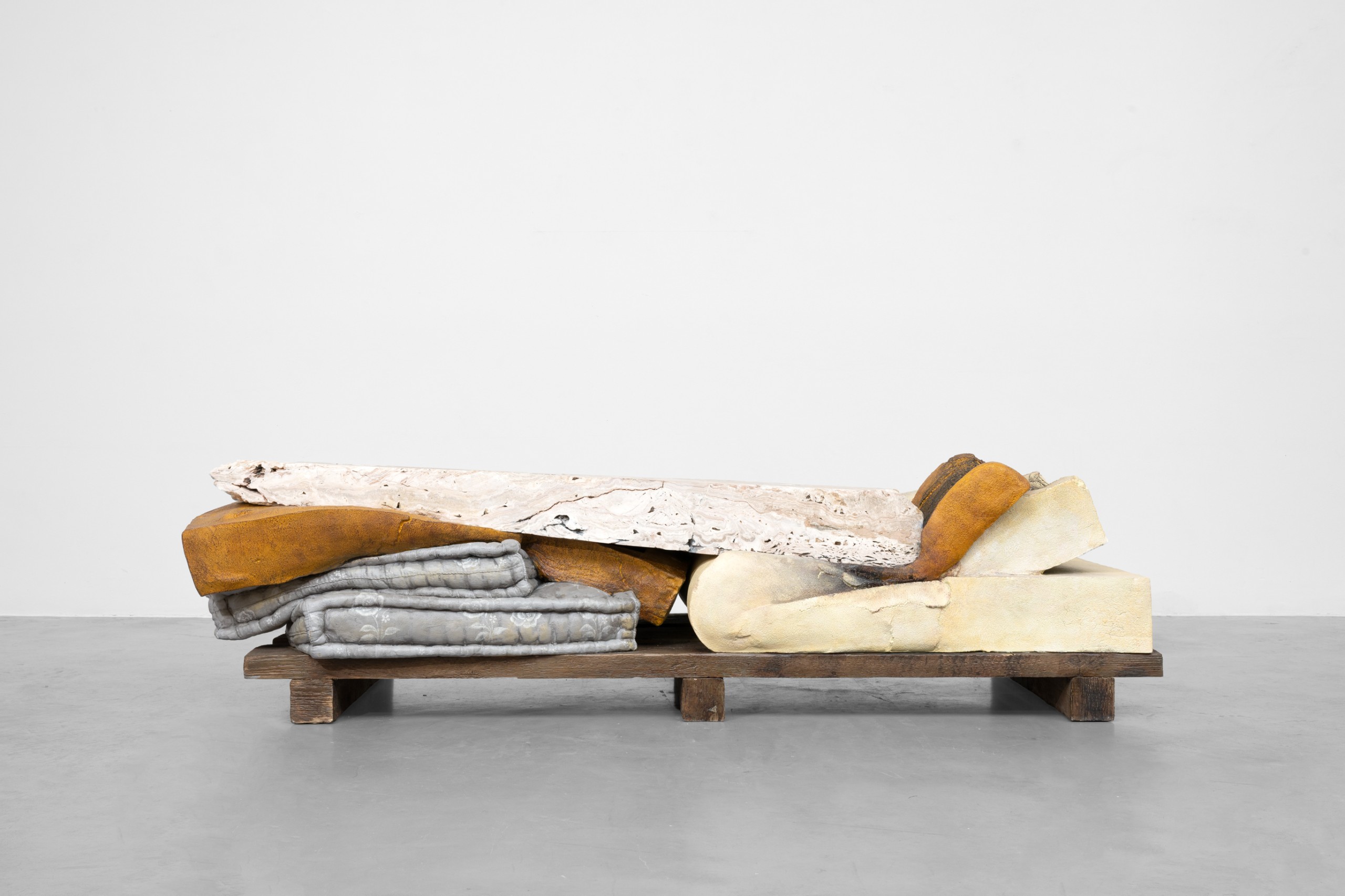
In the basement, Sitting Sculptures (2026), from the series Les Ouvrières invisibles [The Invisible Workers], foregrounds the auxiliary materials that enable sculptures to exist: mattresses, blankets, pillows and foams used to drag heavy and fragile objects around the studio, transport pallets, lifting straps, silicone taken from casting moulds, fragments, casts, residues, and discarded materials all reappear in new forms. Retaining traces of their histories even as they assume new identities, these elements reveal the movement and the hidden labour embedded within sculptural practice.
Upstairs, the porous relationship between drawing and sculpture comes to the fore through a selection from the Les Dessouvenus [The Unremembered] series, begun in 2013, alongside a new series of drawings, Les Auxiliaires [The Auxiliaries]. Across both series, Trouvé’s practice oscillates between chance operation and construction, orientation and disorientation: worlds emerge through chemically altered surfaces, while drawings originate in the chance event of a hair falling across a canvas, preserved beneath tracing paper, its meandering path evoking routes, cables and trajectories.
As the boundaries between studio and exhibition, drawing and sculpture, process and finished work dissolve, Tatiana Trouvé’s works emerge not as fixed entities but as temporary constellations within an exhibition as an open network of transformations. Across shifting relations between objects, materials, gestures and places, works continually change status as they move from one form to another, generating new affinities, echoes and trajectories. Rather than resolving into stable meanings, they remain suspended within an ecosystem without origin or end, where different worlds coexist and continually give rise to one another.
Tatiana Trouvé (b. 1968, Cosenza, Italy) was raised in Dakar, Senegal and now lives and works in Paris, France. The artist’s first solo exhibition took place at the Centre national d’art contemporain at Villa Arson in 1997, and her first retrospective, The Longest Echo, was held at MAMCO, Geneva in 2014. In 2022, she was the subject of a major monographic exhibition, Le grand atlas de la désorientation, at the Centre Pompidou, Paris. In 2025, Pinault Collection dedicated a major exhibition project to the artist at the Palazzo Grassi in Venice. Trouvé is the recipient of numerous awards, including the Pernod Ricard Foundation Prize (2002), the Marcel Duchamp Prize (2007), the ACACIA Prize (Italy, 2014), and the Rosa Schapire Art Prize (Germany, 2019). In 2020, she was named Officier de l’Ordre des Arts et des Lettres by the French Ministry of Culture and Communication.
Uptown - Gallery
Tue-Sat 11am-6pm
6 rue Saint-Georges / 107 rue Saint-Georges / 44 rue Van Eyck, 1050 Brussels
Visit the website
Xavier Hufkens established his eponymous gallery in 1987 in an unrefurbished warehouse in central Brussels. From the beginning, the gallery played a pivotal role in introducing some of today’s most influential contemporary voices to Brussels, including British sculptor Antony Gormley—still represented by the gallery—as well as Felix Gonzalez-Torres and Rosemarie Trockel, both of whom had their Belgian debuts with Xavier Hufkens.
In 1992, the gallery relocated to a 19th-century townhouse in Ixelles, redesigned by Belgian architects Paul Robbrecht, Hilde Daem and Marie-José Van Hee. The elegant, light-filled space quickly became one of Brussels’ most prominent venues for contemporary art. That decade marked a deepening of the gallery’s programme with the addition of artists such as Richard Artschwager, Thierry De Cordier and Jan Vercruysse. In 1997, the gallery expanded into an adjacent building, allowing for larger and more ambitious exhibitions. During this period, Xavier Hufkens became the longest-standing representative of Louise Bourgeois, Roni Horn and Thomas Houseago, forging lasting relationships that would shape the gallery’s identity.
The 2000s saw a continued evolution of the programme and physical footprint. Sterling Ruby debuted in 2009 with a dual exhibition in dialogue with Robert Mapplethorpe’s photography, underscoring the gallery’s sensitivity to resonances between artists across time and medium. In 2013, a second location opened in the iconic 1970s Galerie Rivoli building, designed by Swiss architect Harry Gugger (formerly of Herzog & de Meuron). The Rivoli space has since hosted solo exhibitions by Paul McCarthy, Nicolas Party, Danh Vō, Cathy Wilkes and Zhang Enli, and many others. The gallery further expanded its roster with the addition of Belgian artist Walter Swennen in 2014, followed by acclaimed British artist Tracey Emin in 2015.
In 2020, the gallery welcomed several new artists, including Lynda Benglis and Huma Bhabha, and inaugurated a third Brussels location on rue Van Eyck. Two years later, the original St-Georges gallery reopened following a major renovation and extension by its original architects, Robbrecht & Daem. This period also marked the beginning of collaborations with Cecilia Vicuña, Christopher Wool and the Estate of Milton Avery, and Mark Manders.
Today, Xavier Hufkens stands as one of Europe’s leading contemporary art galleries, celebrated for its curatorial rigour, long-term dedication to artists and estates, and distinctive architectural settings. With a programme that spans generations and geographies, the gallery continues to play a vital role in shaping the contemporary art discourse in Brussels and beyond.