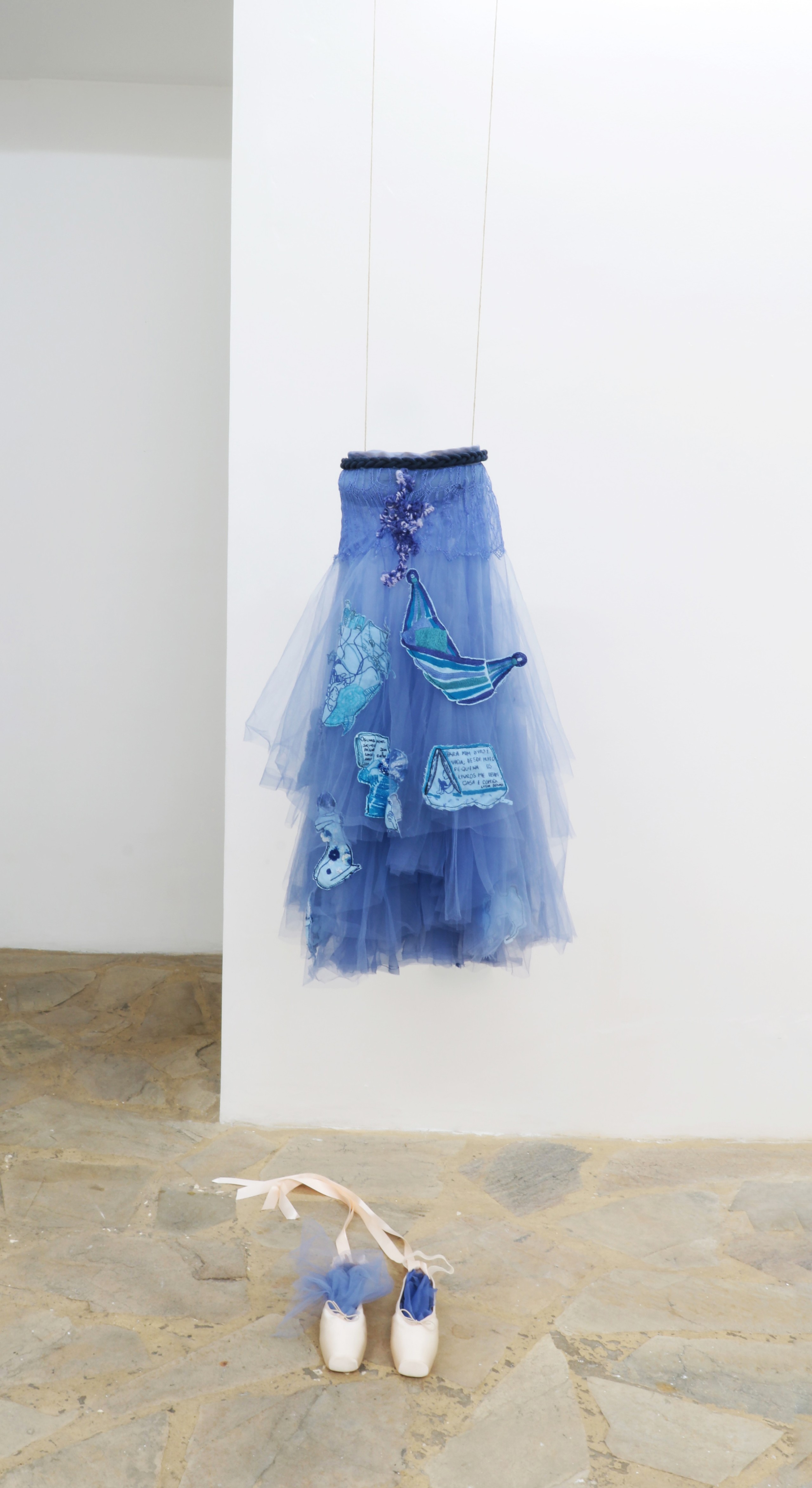
Bianca Ranucci understands what happens to a garment when someone puts it on. How the fabric follows the body, the volume it creates, the proportions that allow movement. After a career in fashion, the artist found in furniture another field in which to explore this knowledge. In Barbatanas, a garment construction technique finds new possibilities for expression.
Flexible, fabric-covered boning, traditionally used to structure garments, is attached externally to the backrest of a chair using snap fasteners. The elements extend its contours, tracing curves that project into space. The intervention expands the chair’s silhouette and changes its presence without concealing the original structure.
The transformation becomes apparent as the eye moves across the work. From the front, the chair retains much of its familiar appearance. Viewed from the side, the boning gains depth, extending beyond the backrest to create a succession of arches. The repetition of these elements establishes a visual rhythm, while the spaces between them allow the surrounding space to become part of the composition. With each change of perspective, new relationships emerge between lines, volumes, and voids.
Bianca imagines the chair twirling, looking wonderful in a room. The image comes from her experience of women turning as they try on her creations, discovering how the fabric moves and follows the body. This relationship between clothing and movement finds another expression in furniture. The chair remains still, yet its silhouette seems to respond to the movement of the viewer.
The choice of support is part of the artistic process. Bianca seeks chairs whose proportions can accommodate the boning, recognising in each design specific possibilities for composition. The original structure remains visible and contributes to the result. The object retains its identity, while the textile elements introduce another material language.
There is also a distinctive construction principle. Just as a garment can fit different bodies, provided their measurements and proportions are compatible, the same boning structure can be removed and installed on another suitable chair. The snap fasteners allow this transfer without permanently altering the furniture. The composition changes according to the support it receives, while the textile structure retains its configuration.
This capacity for movement between supports is integral to the conception of the work. Bianca brings together two structures that coexist without losing their identities. The chair retains its original characteristics, while the boning remains free to find other forms of presentation.
Barbatanas also invites reflection on the relationships between the body, presence, and freedom. The history of boning in women’s clothing opens up further possibilities for interpretation, while Bianca gives it a new function and greater visibility. Furniture, too, can tell stories. Here, the chair takes on a new expression shaped by the artist’s experience.
At BS Galleria in Brussels, two chairs of the same model will be presented together. Each constitutes an autonomous work , yet their proximity allows viewers to observe the repetition of curves and the different spatial relationships created by the boning. The textile structures can be removed, transported, and installed on other compatible chairs. The furniture can return to its original configuration. Yet, while brought together, chair and boning form a particular composition that changes with every new viewpoint. It is within this relationship that Bianca finds room to continue experimenting.
About Bianca Ranucci:
Bianca Ranucci is a Brazilian artist whose practice brings together fashion, textile art and furniture. With a background in womenswear design, she developed an extensive knowledge of pattern-making, garment construction and fabric manipulation that now informs her artistic work. Her practice explores the relationships between the body, objects and materials, incorporating elements traditionally used in clothing into sculptural interventions on furniture and surfaces. Through techniques such as hand embroidery and the application of textile structures, she investigates new possibilities of volume, texture and three-dimensional form.