Eric Mangen
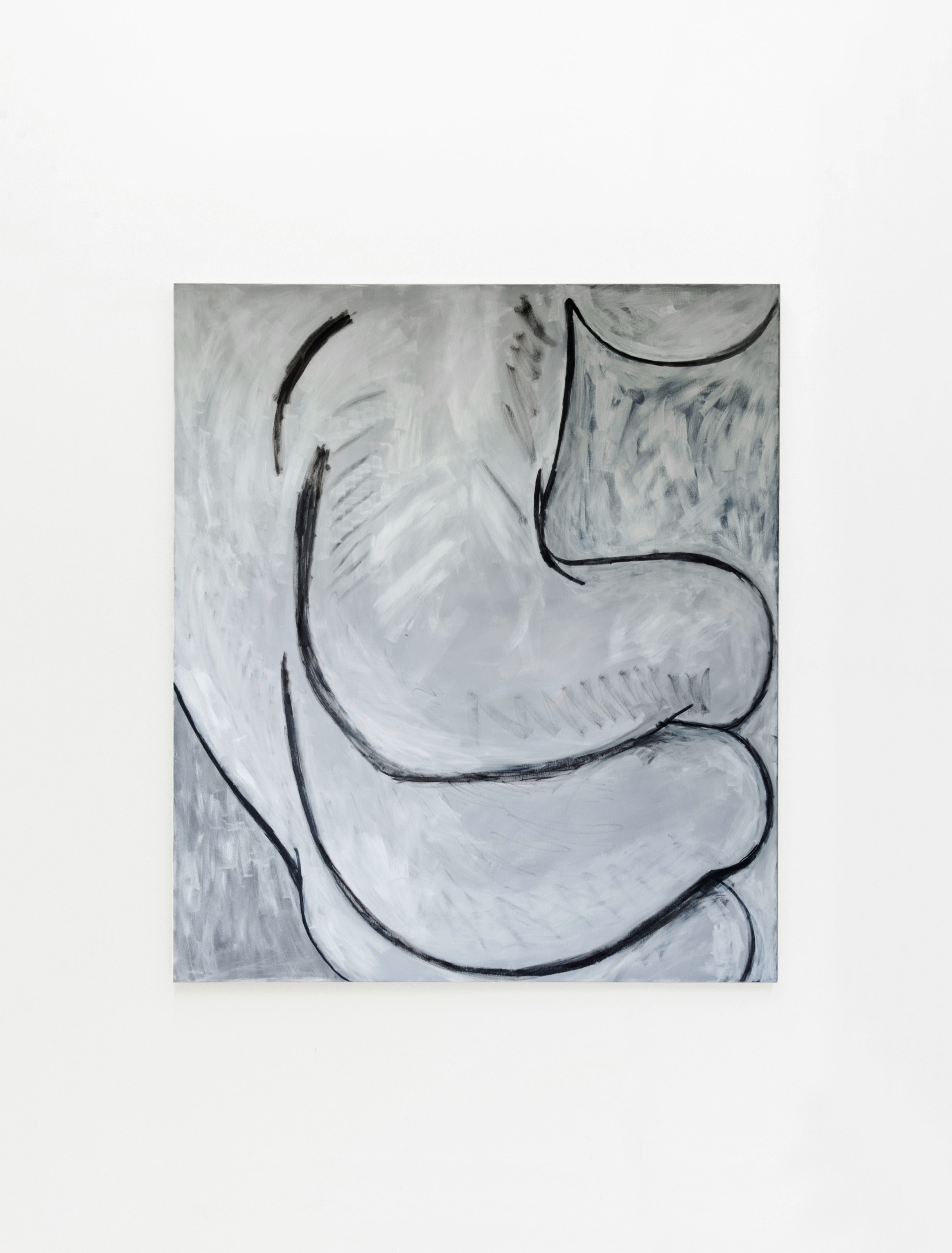
Eric Mangen is a self-taught Luxembourgish artist who first gained recognition through street art and graffiti. After several artist residencies in Australia, the United States, and across Europe, as well as regular collaborations with other contemporary artists, he returned to Luxembourg in 2013.
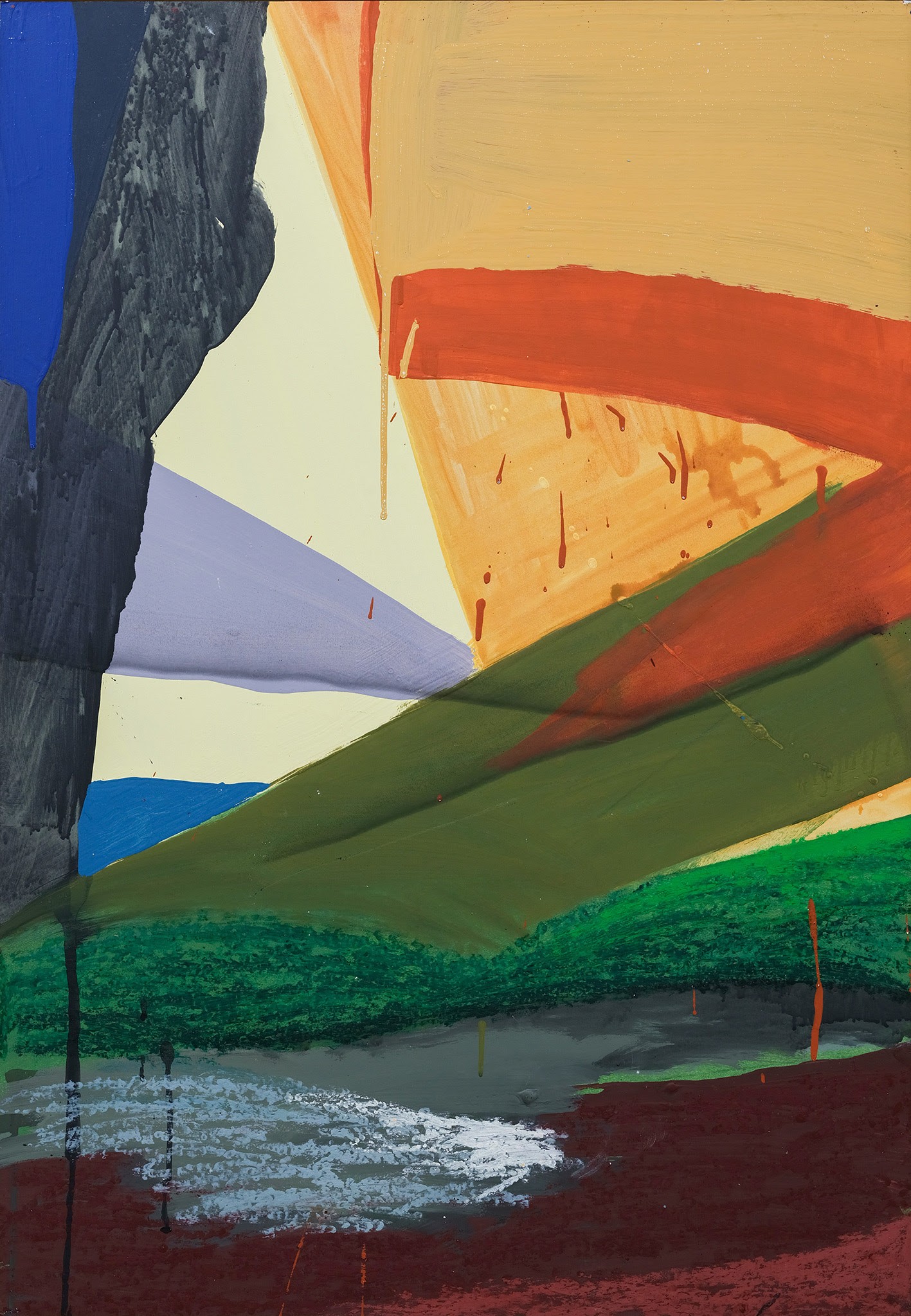
While continuing to work on mural projects, he has since devoted himself entirely to abstract painting. His practice, however, moves away from geometric abstraction and instead seeks to convey the immediate energy of gesture, in the lineage of Action Painting. The use of spray paint introduces an additional distance from the surface, allowing for accidents to occur. The artist then balances the composition by softening his works through powdery bursts and rhythmic interweavings left partly to chance.
He compares his pictorial language, marked by the speed of execution, to a dance between impulsive momentum and controlled restraint. With a dynamic and sensitive graphic approach as its foundation, Éric Mangen remains above all an intuitive artist, free from fixed rules.
Opening on Saturday, 14 March 2026 at 5pm
After training in France at the École des Beaux-Arts de Saint-Etienne and in Germany at the Akademie der bildenden Künste Karlsruhe, Damien Deroubaix established himself as a painter, printmaker, draftsman, and sculptor. Since then, his pictorial language has continually mixed motifs and influences without boundaries in an artistic practice characterized by a diversity of forms and techniques: oil painting, watercolor, engraving, tapestry, woodcuts, as well as sculpture and installation. Old and modern masters, Metal and grindcore aesthetics, non-European arts, and BDSM—the plastic effervescence of Deroubaix knows no limits. A fetishist of style, he leaves his mark on the surface as one tattoos skin. In his blunt opposition to the whiteness of the canvas, Deroubaix kneads the gray and black matter of a skull or rib cage. And even if his work is born from darkness, his anatomical theater remains voracious, ready to swallow everything from the great chaos of the world—its chimeras and its exterminating angels.
Manuel Ocampo
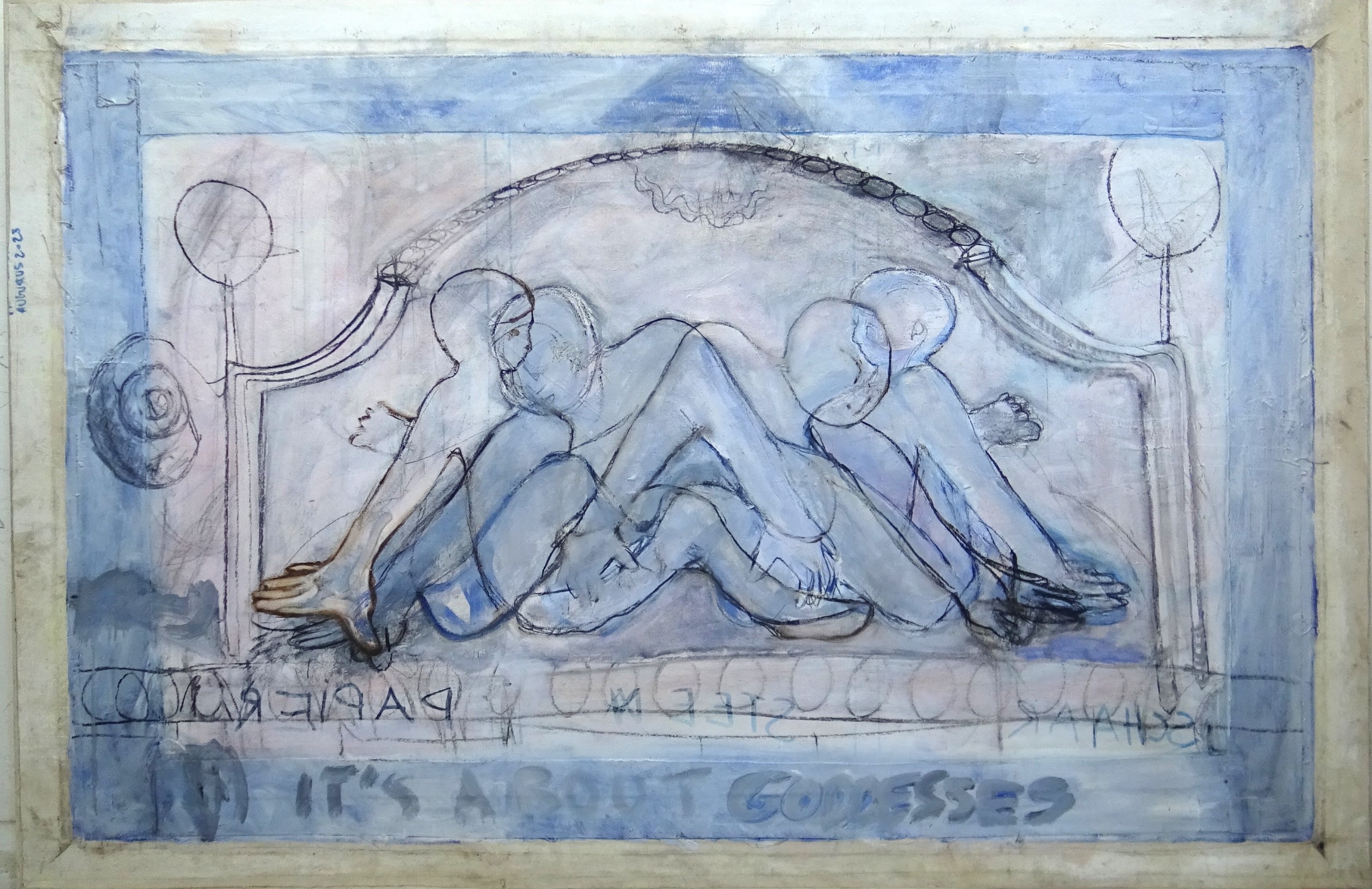
Painting is a cultural object like any other; it often indulges in happiness unburdened by meaning, and sometimes possesses the beauty of comfort. In short, painting is a formidable duplicating machine that needs to please before seeking to be revolutionary. Manuel Ocampo, because he is first and foremost a painter, is indebted to the pictorial tradition as well as to kitsch values. The history of art is also the history of the commercial rise of the bourgeoisie and the construction of colonial empires. Manuel Ocampo formulates a realism of darkness that mocks European mannerism. His stimmung is both beneath and beyond style, mixing pictorial codes and deconstructing their redemptive virtues to infuse them with blasphemy and paganism. Blackface putti and a nude female model in the arms of an Indian lover reject the canons of Western painting through forced miscegenation. There is, without a doubt, in Ocampo’s work, a fabulist function of myths and symbols activated by myriad reflections. An alchemical process emerges that draws from the materiality of painting the power to make gold from mud, summoning Karl Marx and Donald Duck in one fell swoop. If ridicule does not kill, it dishonors. Analogous, Ocampo’s genre scenes reek of sulfur and dung in a secret modernist, pop, baroque language. His canvases assume that they will trip over the carpet and slip into buffoonery. While baseness is expressed in garish tones, the romantic fundamentals are not forgotten: hypersubjectivity and picturesqueness. Ocampo’s rustic landscapes, populated by unfriendly pests such as vultures and rats, thus compose the papier-mâché backdrop of a stupidly barbaric world. These crazy shadows dance not far from Goya’s witches’ sabbaths and war disasters. Ocampo gives voice to simulacra through the masks of a bestiary of cringe-worthy and grotesque creatures. His clandestine weapon is infantile regression, which mimics rather than cheaply denounces the violence of the world. Clearly, the artist is not interested in guilt or indignation. If the texture of reality is full of holes, Ocampo attempts to turn it into a tableau that is as carnivalesque as it is derisory.
R. Lindberg
Opening on Saturday, 14 March 2026 at 5pm
After training in France at the École des Beaux-Arts de Saint-Etienne and in Germany at the Akademie der bildenden Künste Karlsruhe, Damien Deroubaix established himself as a painter, printmaker, draftsman, and sculptor. Since then, his pictorial language has continually mixed motifs and influences without boundaries in an artistic practice characterized by a diversity of forms and techniques: oil painting, watercolor, engraving, tapestry, woodcuts, as well as sculpture and installation. Old and modern masters, Metal and grindcore aesthetics, non-European arts, and BDSM—the plastic effervescence of Deroubaix knows no limits. A fetishist of style, he leaves his mark on the surface as one tattoos skin. In his blunt opposition to the whiteness of the canvas, Deroubaix kneads the gray and black matter of a skull or rib cage. And even if his work is born from darkness, his anatomical theater remains voracious, ready to swallow everything from the great chaos of the world—its chimeras and its exterminating angels.
Damien Deroubaix
After training in France at the École des Beaux-Arts de Saint-Etienne and in Germany at the Akademie der bildenden Künste Karlsruhe, Damien Deroubaix established himself as a painter, printmaker, draftsman, and sculptor. Since then, his pictorial language has continually mixed motifs and influences without boundaries in an artistic practice characterized by a diversity of forms and techniques: oil painting, watercolor, engraving, tapestry, woodcuts, as well as sculpture and installation. Old and modern masters, Metal and grindcore aesthetics, non-European arts, and BDSM—the plastic effervescence of Deroubaix knows no limits. A fetishist of style, he leaves his mark on the surface as one tattoos skin. In his blunt opposition to the whiteness of the canvas, Deroubaix kneads the gray and black matter of a skull or rib cage. And even if his work is born from darkness, his anatomical theater remains voracious, ready to swallow everything from the great chaos of the world—its chimeras and its exterminating angels.
Recently, his exhibition En un jour si obscur was shown at the Bibliothèque nationale de France in Paris, where his panels, prints, engravings, and paintings dialogued with the masters of European printmaking from the library’s collections (2025), and La vida es sueño at the Musée Goya de Castres (2024). Damien Deroubaix’s work is held in major collections including the Centre Pompidou (FR), the Museum of Modern Art New York (USA), the Saarlandmuseum (DE), the Museu Colecção Berardo (PT), and the Kunstmuseum St. Gallen (CH). The artist has also exhibited internationally, notably at the Fondation Maeght (France), Bloomberg Space (United Kingdom), the Espace Culturel Louis Vuitton (France), the Casino Luxembourg (Luxembourg), the Künstlerhaus Bethanien (Germany), and the MUDAM (Luxembourg), among others. In 2009, he was nominated for the Prix Marcel Duchamp.
Opening on Saturday, 14 March 2026 at 5pm
After training in France at the École des Beaux-Arts de Saint-Etienne and in Germany at the Akademie der bildenden Künste Karlsruhe, Damien Deroubaix established himself as a painter, printmaker, draftsman, and sculptor. Since then, his pictorial language has continually mixed motifs and influences without boundaries in an artistic practice characterized by a diversity of forms and techniques: oil painting, watercolor, engraving, tapestry, woodcuts, as well as sculpture and installation. Old and modern masters, Metal and grindcore aesthetics, non-European arts, and BDSM—the plastic effervescence of Deroubaix knows no limits. A fetishist of style, he leaves his mark on the surface as one tattoos skin. In his blunt opposition to the whiteness of the canvas, Deroubaix kneads the gray and black matter of a skull or rib cage. And even if his work is born from darkness, his anatomical theater remains voracious, ready to swallow everything from the great chaos of the world—its chimeras and its exterminating angels.
Uptown - Gallery
Wednesday-Saturday, 11:00-18:00
Rue de la Concorde 60/A, 1050 Ixelles
Visit the website
Nosbaum Reding gallery was founded in 2001 by Véronique Nosbaum and Alex Reding. Located in the historic centre of Luxembourg, it operates two separate yet adjacent exhibition spaces which allow for simultaneous presentations. Since its inception the gallery has been focussing on young artists from Luxembourg and neighbouring countries, shown alongside internationally established artists. With a strong emphasis on figurative and conceptual painting, its programme of exhibitions embraces a wide range of artistic practices including video, photography, sculpture- and installation-based media. Nosbaum Reding has always been keen to promote emerging artists by producing new work for their exhibitions and supporting them in their exploration of new ideas and concepts. Working from a strong local and regional base, the gallery continuously expands its reach by participating regularly in Europe’s main art fairs and frequently collaborates with renowned galleries and museums.
Nosbaum Reding Projects (since 2014) is a programme of exhibitions showcasing young emerging artists from around the world.